Cyber Surfer : Rhythm Odyssey
- 4.4
- Rating
- 50.00M
- Installs
- Free
- Price
 Analysis by App-foxy
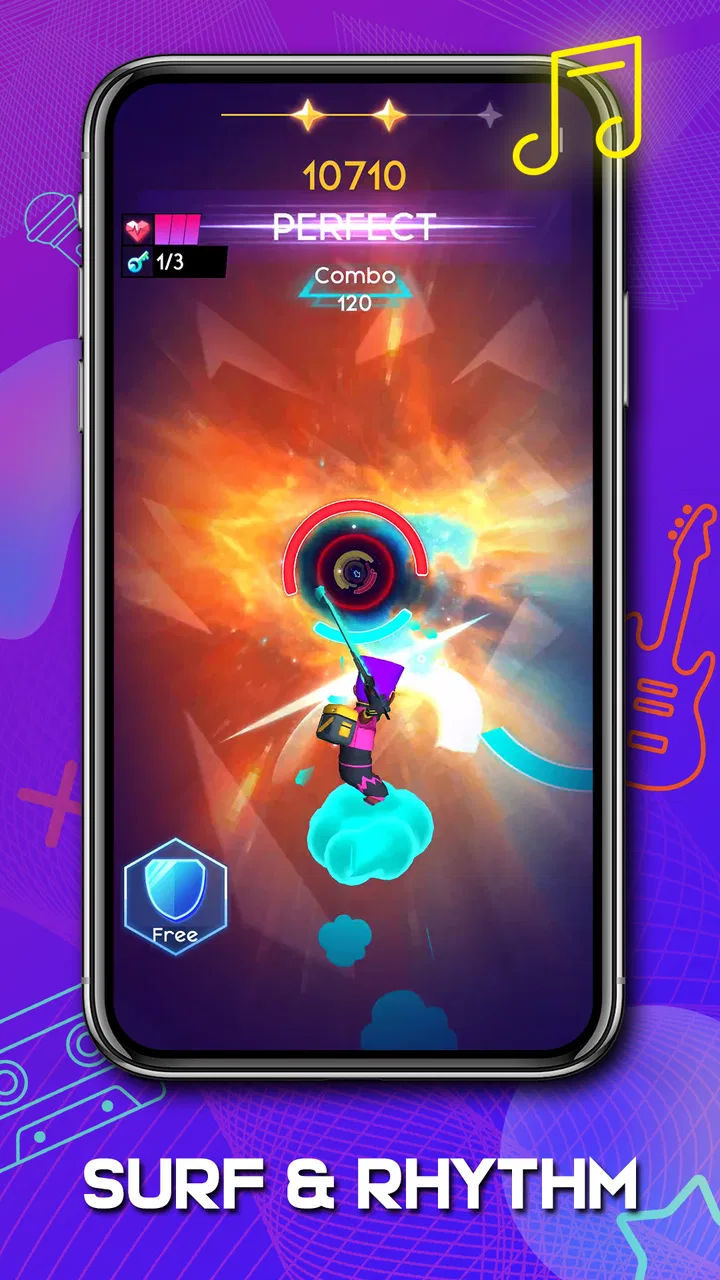
I spent time with Cyber Surfer: Rhythm Odyssey as a music game, and my first impression was clear: it is built for players who want rhythm practice wrapped in a fast, colorful action challenge. You guide a skateboarder through music while cutting through targets with a lightsaber, so the appeal comes from matching movement, timing, and visual direction rather than simply tapping a beat.
That combination gives it a different feel from a traditional rhythm game. Instead of watching a fixed lane and pressing notes in sequence, I found myself reacting to the track while also paying attention to where the character was moving. It feels closer to a short arcade session than a passive music player, which makes it easy to pick up when I have only a few minutes.
The game is free to download, with optional in-app purchases ranging from $0.99 to $19.99 per item. It carries a Teen content rating, and it runs on Android 7.0 or later. Those details make it accessible to a broad range of phones, although the bright effects and quick action are better suited to players who enjoy stimulation rather than calm, background play.
You May Also Like

 AccuWeather: Weather Radar
AccuWeather Review: A Quick, Clear Forecast for Everyday Decisions
For everyday plans, the best forecast is the one you can understand quickly. AccuWeather makes rain timing, radar, and local conditions easy to act on, with a few trade-offs.

 Hill Climb Racing
Why Hill Climb Racing Still Turns Crashes Into One More Run
A tiny car, a bumpy hill and one more upgrade: Hill Climb Racing keeps resurfacing because its simple chaos makes every near-miss feel personal.

 AliExpress - Shopping App
AliExpress Makes Global Shopping Feel Personal, but Shoppers Bear the Risk
AliExpress turns a global marketplace into a pocket-sized discovery engine. Its reach is useful, its shopping loop compelling, and its trade-offs easy to miss.

 Lords Mobile: Kingdom Wars
Lords Mobile Is a Kingdom-Building Routine, Not a Quick Match
A case-by-case verdict on the building, battles, device demands, and social commitments that make Lords Mobile rewarding for some players and exhausting for others.

 PDF Scanner app - TapScanner
TapScanner Makes Paperwork Easier to Capture, Check, and Share
TapScanner makes scanning with a phone feel less like a rescue operation and more like a dependable step in getting work done. Its capture tools are useful, though not flawless.

 Block Blast!
 Shows How Much a Puzzle Game Can Leave Out
A quiet grid game shows why puzzle players increasingly value instant clarity, repeatable skill and low-pressure play—and where the genre still needs to catch up.
More From Our News Desk
View All News


How the current version feels to play
The central loop is simple to understand. Music drives the action, the skateboarder moves through a futuristic course, and I use the lightsaber to respond to incoming elements. The controls are deliberately direct, which is important because rhythm games become frustrating when the input system gets in the way of the beat.
What makes the experience work is the need to combine two kinds of attention. I am not only listening for timing; I am also reading the path ahead. A player who concentrates exclusively on the music can still miss the visual cues, while someone who watches only the screen may lose the rhythm. The best runs happen when both senses are working together.
I recommend starting with short sessions instead of immediately trying to play for a long stretch. The repeated swiping and visual tracking can become tiring, especially on a smaller phone. A few focused attempts are more useful than rushing through many songs while your timing is getting worse.
One practical tip is to lower distractions around you before playing seriously. The game’s neon presentation is part of its charm, but it also means the screen can become busy. Playing in a bright room and keeping the display clean helped me distinguish the moving targets more easily. This is a small adjustment, but it matters when a late reaction costs a run.
A rhythm game with an arcade mindset
I would not describe this as a replacement for a deep music library or a specialist rhythm simulator. Its strength is immediacy. I can open it, choose a track, and understand the objective without reading a long tutorial. That makes it a good fit for casual players, younger teens who enjoy action games, and anyone who likes music games but wants more movement than a standard note chart provides.
Compared with conventional tap-to-the-beat games, this one asks more from spatial awareness. Compared with endless runners, it gives the music a more important role in determining how the session feels. The trade-off is that players looking for precise, minimalist rhythm training may find the visual action distracting. A simpler lane-based game is probably better if your main goal is measuring timing with as little visual noise as possible.
The skateboard setting also changes the mood. It gives the game momentum and a sense of forward motion, while the lightsaber adds a physical action to each musical phrase. I enjoyed that combination because successful moments feel active rather than merely accurate. At the same time, it can make mistakes feel more abrupt than in a relaxed music game, particularly when I was still learning how the visual cues lined up with the sound.
What the version and release history suggest
The game was released on February 7, 2021, and the current version is 5.8.18. That places it well beyond its initial launch stage, so I approached it as an established title rather than a first experiment. The version number indicates ongoing maintenance and evolution, but I would separate that fact from any assumption that every update changes the core experience. The basic identity remains the same: music-led movement, skateboard momentum, and lightsaber interaction.
For someone installing it today, the practical benefit of a mature version is that the experience is not defined only by its original launch concept. I found the game easier to judge as a complete package, with its visual style and control loop already firmly established. However, a mature game can also feel less welcoming to a brand-new player if it has accumulated layers of content or progression over time. I would give the opening sessions a little patience before deciding whether the pace suits you.
The developer, BADSNOWBALL HONGKONG LIMITED, has kept the title positioned as a music game rather than shifting it into a completely different genre. That consistency is valuable for existing users. If you liked the original idea of surfing through a song while making timed cuts, the current release still speaks the same language.
At the same time, I would avoid treating the version number as a promise of a particular feature or improvement. A newer build tells me the product has continued to receive attention, but it does not automatically make the controls more precise or the music more diverse for every player. Those are things I judge through actual play, and the main appeal remains the distinctive action-rhythm blend.
Who will get the most from it
This is a strong choice for players who like energetic mobile sessions. If you enjoy neon visuals, quick reactions, and music that directly controls the pace of play, you will probably understand the appeal within a few attempts. It also works well for people who want a game that can be played in short bursts without requiring a large commitment each time.
A realistic everyday use case is a short break between tasks. I might play one or two tracks while waiting for an appointment or taking a pause from work. The game gives that break a clear beginning and end, unlike a large role-playing game that can tempt me into a much longer session. The important point is to treat it as an arcade-style reset, not as something that must fill an entire evening.
It can also suit friends or family members who want to compare reactions informally. One person may be better at reading the path, while another may have stronger musical timing. That difference makes the game approachable even when players have different gaming backgrounds. I would still keep the Teen rating in mind when choosing it for younger users.
Players who should skip it are those who dislike rapid visual movement, repeated attempts, or games where music and reflexes are tightly connected. It is also not my first recommendation for someone seeking a quiet, low-pressure listening experience. A music streaming app or a slower puzzle game would serve that need better.
Small techniques that improve the experience
My first useful technique was to learn the visual rhythm before chasing a perfect run. On an early attempt, I paid attention to how the track presents upcoming actions and where my eyes naturally went when the screen became crowded. That made later attempts less about panic and more about anticipating the next movement.
A second technique is to separate practice goals. I might focus on staying aligned with the course during one attempt, then concentrate on cleaner saber timing during the next. Trying to improve every part at once makes it difficult to understand why a run failed. Breaking the challenge into one skill at a time gives the game a more satisfying learning curve.
A third trade-off involves sound and display. Turning the volume down can make a quick session more comfortable in public, but it removes some of the timing information that gives the game its identity. When I play seriously, I prefer a level where I can hear the beat clearly. When I am only testing a track, I can accept that reduced feedback and focus on the visual side.
I also found that phone size changes the feel more than I expected. A larger display makes the course easier to read, while a compact screen can make the same action feel compressed. That does not make the game unusable on a smaller device, but it favors shorter sessions and more deliberate attention. If the controls feel inconsistent, I would first check whether my fingers are covering too much of the play area before blaming the game.
Where the free model can create friction
The free entry point is a genuine advantage because it lets me test the control style without paying first. That matters here: the concept is unusual enough that some players will love it immediately while others will prefer a conventional rhythm format. Being able to try the core experience lowers that risk.
The trade-off is the presence of optional purchases. Items range from $0.99 to $19.99, so I would recommend deciding in advance whether you are comfortable spending money inside the game. A free download can feel very different from a completely cost-free experience, especially for players who want access to everything without interruptions or purchase prompts.
My advice is to play long enough to decide whether the movement itself is enjoyable before considering any purchase. If the basic rhythm-action loop does not feel satisfying, extra content will not solve that problem. If you already enjoy the sessions and want to support continued use, then spending should be a deliberate choice rather than a reaction to frustration.
This is also where expectations matter. I would not choose the game assuming it will replace every other music title on my phone. Its value comes from the specific combination of skating, visual reaction, and saber action. Players who want a broad musical catalog, a pure score-chasing environment, or a completely uninterrupted experience may be happier with a different category of app.
What existing players may notice over time
For returning users, the current release should feel familiar rather than radically reinvented. The core loop is strong because it is easy to recognize and quick to restart, but that same consistency can feel limiting if you want a completely new style of play. I see the game as something to revisit for the feel of its action, not as a title that needs to transform every time I open it.
The large audience gives the game a reassuring level of visibility. It has an average rating of 4.4 from around 121 thousand ratings, with roughly 6 thousand written reviews, and it has passed 50 million installs. Those figures suggest that the concept has reached well beyond a tiny niche, although popularity alone cannot tell me whether its particular control style will suit my hands or musical taste.
For a new player, that audience can make the game easier to justify trying, but I would still pay attention to my own first ten minutes. Rhythm games are personal: latency, screen size, hearing conditions, and tolerance for visual effects all influence enjoyment. A widely played title can still be the wrong fit if its interaction style does not feel natural to you.
Remaining gaps and sensible expectations
The biggest limitation is the tension between spectacle and clarity. The futuristic presentation helps the game stand out, but visual intensity can compete with the information I need to read quickly. Players with strong reflexes may enjoy that pressure; players who prefer clean, calm interfaces may find it tiring.
Another limitation is that the game’s appeal depends heavily on repetition. Improving timing usually means replaying situations until the response becomes familiar. I enjoy that when I am in the mood to practice, but it can feel narrow if I want constant novelty. This is not a flaw unique to rhythm games, yet the skateboard-and-saber format makes the repeated pattern especially noticeable.
I would also be cautious about using it as a substitute for exercise. The movement is on-screen, not a full-body workout, and the main challenge is coordination rather than physical training. It is better understood as an active-feeling mobile game than as a fitness tool.
Device compatibility is reasonably broad because it supports Android 7.0 and later, but operating-system support does not guarantee identical comfort across phones. Older or smaller devices may make the visual action less pleasant, while newer displays can make the neon style more enjoyable. I would judge performance and readability on the actual phone I plan to use rather than assuming the minimum system requirement tells the whole story.
What I would watch before committing
If I were deciding whether to keep playing, I would watch how quickly the novelty turns into a satisfying routine. The first few sessions are carried by the unusual premise, but long-term value depends on whether I enjoy improving my timing and route reading. That is the real test for this game.
I would also pay attention to how the purchase options fit my habits. Because the game is free to start, I can make that decision gradually. I would avoid spending simply because a difficult section feels irritating, and I would make sure the core controls are already enjoyable before paying for anything.
Finally, I would compare it honestly with the alternatives I already use. If I want a precise, stripped-down rhythm challenge, I would choose a traditional rhythm title. If I want a relaxed music companion, I would choose something that does not demand constant reactions. If I want a distinctive arcade game that makes me listen, watch, and swipe at the same time, Cyber Surfer: Rhythm Odyssey is much easier to recommend.
My overall view is positive but specific. This is not a universal music game, and its bright, demanding presentation will not suit everyone. For me, its best quality is the way it turns a song into a short physical-feeling challenge without requiring complicated controls. The free price makes trying it straightforward, while the Teen rating, optional purchases, and visual intensity are worth considering before handing it to a younger player.
I would recommend it to anyone who wants a quick futuristic arcade experience with a real rhythm component. Start with short sessions, listen carefully, and learn the visual flow before chasing high performance. If that combination of music, skating, and saber timing clicks with you, the game has enough character to earn a place in your regular rotation. If you prefer calm interfaces or pure beat accuracy, there are better alternatives for your particular goal.
FAQs for Cyber Surfer : Rhythm Odyssey
01What is the main objective of Cyber Surfer: Rhythm Odyssey?
Cyber Surfer: Rhythm Odyssey is a music-based game where players need to surf through vibrant tracks, collecting points and avoiding obstacles. The main objective is to synchronize movements with the rhythm of the music while achieving high scores and unlocking new levels and music tracks.
02Is Cyber Surfer: Rhythm Odyssey free to play?
Yes, Cyber Surfer: Rhythm Odyssey is free to download and play. However, it offers in-app purchases for players who want to enhance their gaming experience. These purchases can include new skins, tracks, or ad-free gameplay options. Be mindful of in-app purchase settings if you're concerned about spending.
03What are the system requirements for Cyber Surfer: Rhythm Odyssey?
For Android users, the game typically requires Android 5.0 or higher, while iOS users need iOS 10.0 or later. The game is optimized for smartphones and tablets, but it's advisable to check the specific app store listing for the most accurate and updated requirements.
04Can I play Cyber Surfer: Rhythm Odyssey offline?
Cyber Surfer: Rhythm Odyssey can be played offline, allowing users to enjoy the game without an active internet connection. However, certain features like updates, leaderboards, and additional content downloads will require internet access. Ensure to download your favorite tracks before going offline.
05Are there any accessibility options in Cyber Surfer: Rhythm Odyssey?
Yes, Cyber Surfer: Rhythm Odyssey includes several accessibility features. Players can adjust the game’s difficulty, volume settings, and visual effects to suit their preferences. These options are designed to make the game more enjoyable and inclusive for players with different needs.
Pros
- Engaging rhythm-based gameplay.
- Vibrant graphics and animations.
- Variety of music tracks available.
- Intuitive controls for smooth play.
- Regular updates with new content.
Cons
- In-app purchases can be pricey.
- Ads interrupt gameplay experience.
- Limited customization options.
- Requires internet for some features.
- Repetitive levels over time.

Cyber Surfer : Rhythm Odyssey
Gallery